How Long Does Polymer Terrazzo Floor Coating Take to Cure?
Polymer terrazzo floor coating does not reach every form of readiness at the same moment. Under normal conditions, a DIMERY system is typically surface dry in 4–8 hours, usable in approximately 48–72 hours, and fully cured in about 3–7 days. Those figures are planning ranges, not permission to apply every load at the earliest time. The final schedule depends on substrate temperature, ambient humidity, layer thickness, ventilation, site moisture and the type of traffic the floor must carry.
This distinction matters because a floor can feel dry while the resin network is still developing its mechanical and chemical resistance. Opening too early can leave impressions, reduce gloss, trap contamination or damage the bond between layers. For a multi-layer polymer terrazzo floor coating system, cure planning should begin before mixing and continue until the finished floor is approved for its intended service.
Epoxy Floor Curing Time: The Direct DIMERY Answer
The most useful answer is a sequence rather than a single number. At 20°C, the mixed DM-402 material has an application window of approximately 15–20 minutes. Once placed, the terrazzo layer normally needs about 4–8 hours to become surface dry. No one should step on the material before this stage, and surface dry should not be interpreted as ready for unrestricted foot traffic.
Under normal conditions, the current DIMERY product specification identifies 48–72 hours as a typical usable window. This is the point at which carefully controlled access may be possible after site inspection. Complete cure generally takes 3–7 days depending on temperature and humidity. For formal handover or demanding service, the more conservative temperature-based schedule later in this article should be used rather than assuming that the earliest normal-use figure applies to every project.
The clock also needs a clear starting point. A polymer terrazzo flooring system can include primer, intermediate layer, polymer terrazzo layer and protective topcoat. Each layer has its own reaction and intercoat requirements. “Three days after work began” is not the same as “three days after the final coat.” The approved return-to-service time normally starts after the last relevant coat is completed under compliant conditions.
Resin Floor Drying Time vs Full Cure Time
Resin floor drying time describes an early surface condition; full cure time describes the development of the coating’s intended properties. A surface-dry floor may no longer transfer material when lightly checked, yet it can still be vulnerable to pressure, water, cleaning chemicals and concentrated loads. This is why judging cure only by touch is unreliable.
Four terms should remain separate in a project schedule. Pot life is the usable time after Parts A and B are mixed. Surface dry is the first non-tacky stage and establishes the minimum period during which the area must remain untouched. Usable or return to service means the floor can accept a defined level of access after inspection. Full cure means the system has reached the cure level specified for its designed mechanical and chemical performance. A facility manager should always attach a load description to the word “usable”: light inspection, normal pedestrians, wheeled equipment and chemical washdown are not equivalent.
The difference is particularly important for decorative resin flooring. A premature footprint may not cause immediate structural failure but can permanently alter surface texture or gloss. Early water exposure can mark or cloud some incompletely cured layers, while aggressive cleaning can affect the protective topcoat before it has developed adequate resistance. Waiting for the appropriate milestone protects both appearance and service life.
Polymer Terrazzo Curing Schedule: From Pot Life to Return to Service
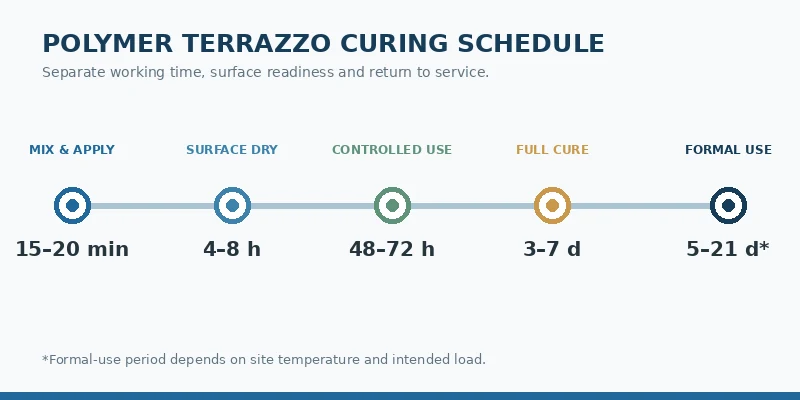
The following polymer terrazzo curing schedule combines the DIMERY manual and current product-page guidance. It is a planning reference for normal, compliant installation conditions; the approved project method statement and site inspection take priority.
| Stage | DIMERY planning reference | What it means on site |
|---|---|---|
| Epoxy floor coating pot life | 15–20 minutes at 20°C | Apply the mixed batch immediately within its working window. Do not thin or try to restore material that has begun to react. |
| Surface dry | Usually 4–8 hours | Keep the area closed and do not step on the coating before it reaches this stage. Surface dry is not full cure. |
| Normal usable window | Approximately 48–72 hours under normal conditions | Controlled use may be possible after checking hardness, surface condition and site conditions. It is not automatic approval for heavy traffic or chemical exposure. |
| Full cure time | Generally 3–7 days | Cure develops according to temperature and humidity; formal service may require the conservative schedule below. |
| Formal return to service | At least 5–21 days depending on temperature | Use the temperature table and the intended load to set handover timing. |
Good scheduling includes protected cure time after every layer, not just installation time. The area should be isolated from dust, water, falling debris and unrelated trades. Dust-free ventilation is helpful, but strong direct airflow can produce uneven surface conditions. The complete A and B packs should be conditioned at 20–25°C for at least 24 hours before mixing, and complete-pack proportions must be maintained. More process details are available in the DIMERY polymer terrazzo installation guide.
Epoxy Floor Curing Time by Temperature and Humidity
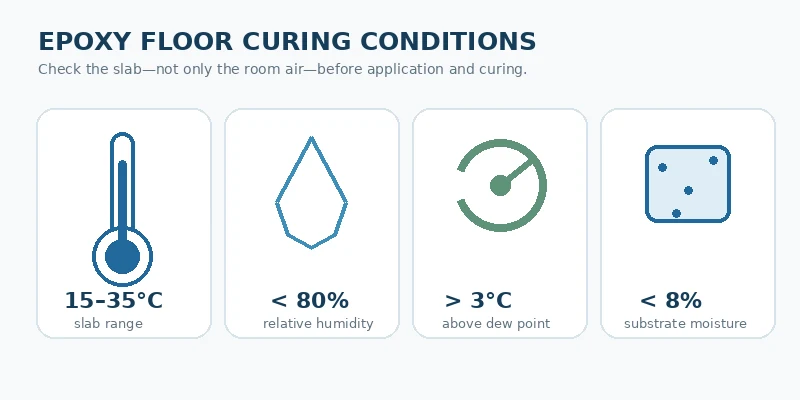
Temperature has a direct effect on epoxy floor curing time, but the relevant measurement is not only the room thermostat. The substrate must also be within the specified range. For DM-402, the basic application range is a substrate temperature of 15–35°C, with 20–25°C preferred. The substrate should remain at least 3°C above the dew point, ambient relative humidity should be below 80%, and substrate moisture should be below 8%.
The DIMERY manual uses the following conservative minimum periods for formal use and maintenance:
| Site temperature | Minimum period before formal use/maintenance |
|---|---|
| Above 20°C | At least 5 days |
| 15–20°C | At least 10 days |
| 10–15°C | At least 15 days |
| 5–10°C | At least 21 days |
This table explains why 48–72 hours must not be treated as an absolute promise. A warm, stable project under normal conditions may enter controlled use in that range, while a cool slab can require a much longer protected period before formal service. Even within the same building, perimeter zones, doorways and slabs over cooler spaces may cure at different rates.
Humidity and condensation introduce a second risk. When a slab approaches the dew point, invisible moisture can interfere with adhesion or surface quality. High humidity can also change the drying rate and increase the risk of early moisture exposure. Heating, dehumidification and ventilation should therefore be planned as controlled site conditions, not improvised after the coating remains tacky. Any temporary heating method must avoid contamination, condensation and local hot spots.
Epoxy Floor Coating Pot Life and Intercoat Timing
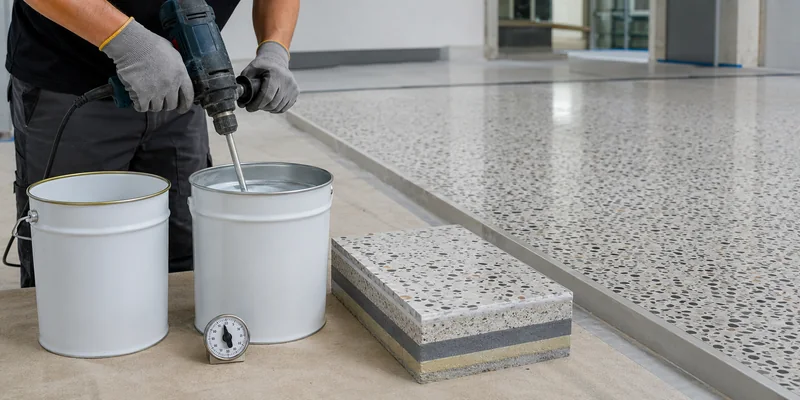
Epoxy floor coating pot life is not the same as floor curing time. Pot life begins as soon as the resin and hardener are mixed, and the reaction can accelerate inside the container because heat cannot dissipate efficiently. At 20°C, DM-402 provides approximately 15–20 minutes of workable time. The crew, tools, substrate and material distribution plan must be ready before mixing starts.
Using material beyond its pot life can reduce flow, wetting and bond quality even if it still looks spreadable. Adding thinner or changing the A-to-B ratio is not an acceptable way to extend working time. DIMERY specifies complete-pack mixing rather than splitting packs on site. Batch size and crew output should be coordinated so that every mix is placed consistently within its application window.
Intercoat timing is equally product-specific. A polymer terrazzo flooring system is a build-up, not one thick coat. The next layer must be applied only when the previous layer has reached the condition required by the method statement. Coating too early can trap a soft or reactive layer; waiting beyond an allowable intercoat window may require mechanical preparation to restore adhesion. Because the permissible interval depends on the selected primer, intermediate coat, terrazzo layer and topcoat, the project team should follow the approved system data rather than infer an interval from a generic epoxy article.
Return to Service for Commercial Resin Flooring Systems
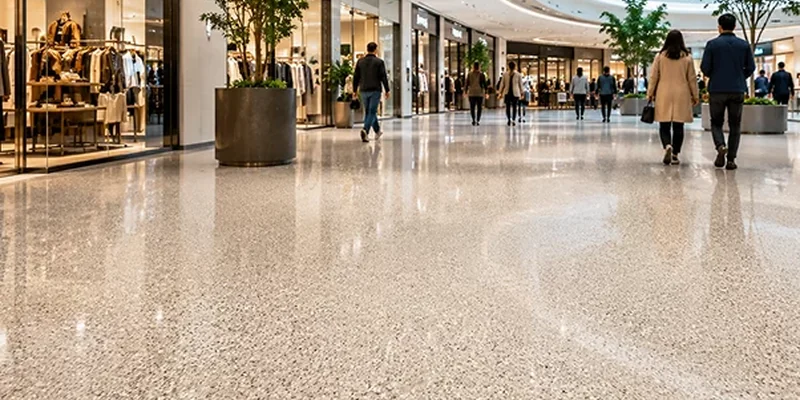
Return to service should be defined by the real operation of the space. In commercial spaces, early access may involve installers wearing clean, soft footwear, followed by normal pedestrian traffic and only later by furniture movement, trolley wheels or wet cleaning. Each activity creates a different load. Small hard casters and metal feet can impose far higher local pressure than a person walking across the floor.
In industrial and warehousing resin flooring systems, the difference is larger. Forklifts, pallet trucks, turning wheels, vibration, oils and cleaning chemicals should not be grouped under the phrase “ready for traffic.” Heavy or chemically aggressive service should wait until the specified formal-use period has passed and the floor has been inspected. Equipment should not be parked in one place during early cure because sustained point loading can mark a coating that appears dry.
A practical handover plan records the final-coat completion time, slab and air temperatures, relative humidity, restricted-access period, first pedestrian date, first equipment date and first wet-cleaning date. It also identifies who has authority to release the floor. This converts cure guidance into an operational control rather than leaving occupants to make assumptions from appearance.
Epoxy Floor Curing Problems: Signs the Resin Floor Is Not Ready
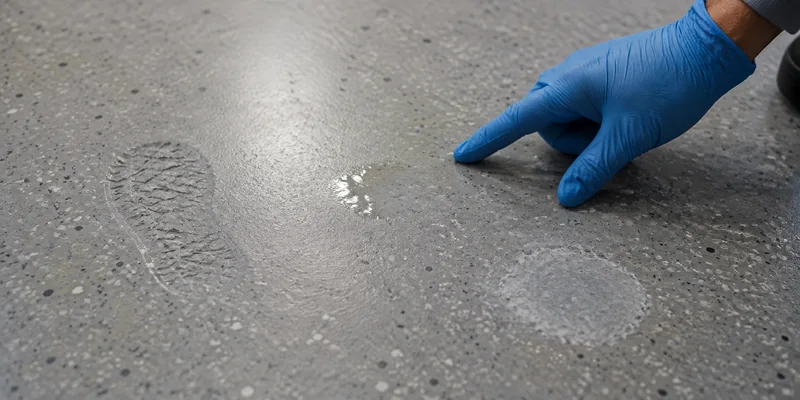
A floor that remains tacky, soft or easily marked beyond the expected resin floor drying time should not be covered, washed or forced into service. Other warning signs include uneven gloss, oily patches, material transfer, strong local differences in hardness, whitening after moisture exposure, or a coating that can be indented with light pressure. These symptoms do not all have the same cause, so applying another coat without diagnosis can bury the defect rather than solve it.
The first review should compare actual slab temperature, air temperature and humidity with the application record. The team should then confirm batch numbers, full-pack mixing, mixing time, application time, thickness, ventilation, substrate moisture and whether water or contamination entered the area. Cold conditions may simply require more time, but an incorrect mixing ratio, incomplete mixing or contaminated substrate may prevent normal cure. Material that has failed chemically cannot be repaired by waiting indefinitely or by adding heat without technical assessment.
If the expected milestone has been missed, isolate the area and contact the flooring supplier or project engineer. Record conditions and take photographs before disturbing the surface. The correct response may range from extending the protected cure period to removing affected material and reinstating the layer. A controlled diagnosis protects the bond between the resin floor coating and the substrate as well as the visible finish.
Polymer Terrazzo Floor Coating FAQs
When can you walk on an epoxy floor?
For DIMERY polymer terrazzo floor coating, do not step on the surface before the typical 4–8 hour surface-dry stage. That stage alone is not general permission for foot traffic. Under normal conditions, controlled use is commonly planned at 48–72 hours, subject to inspection. Cooler temperatures or demanding service can require the longer formal-use schedule.
Can fans or heaters reduce epoxy floor curing time?
Controlled temperature, dehumidification and dust-free ventilation can help maintain the specified environment, but they are not shortcuts for incorrect mixing or unsuitable moisture conditions. Avoid strong direct airflow, combustion contamination and local overheating. Any acceleration plan should be approved for the selected system.
Why is the resin flooring still tacky after the expected time?
Possible causes include a cold substrate, high humidity, condensation, incorrect A-to-B ratio, incomplete mixing, excessive thickness or contamination. Keep the area closed and review the installation records with the supplier. Do not add topcoat until the cause and remedial method are confirmed.
Can the polymer terrazzo floor be wet-cleaned after 48–72 hours?
Not automatically. The usable window and resistance to wet cleaning or chemicals are different milestones. Follow the approved handover schedule and, for demanding cleaning regimes, wait for formal release after the relevant cure period.
Does full cure time start after the first coat or the final coat?
For return-to-service planning, the relevant period normally starts after completion of the final functional coat. Earlier layers still need their specified intercoat cure, so the full project programme must include every layer and all waiting periods.
Plan Your Polymer Terrazzo Curing Schedule with DIMERY
A reliable polymer terrazzo curing schedule is built around the exact system, site climate and operating load. The headline range—4–8 hours to surface dry, approximately 48–72 hours to normal usable status, and generally 3–7 days to full cure—helps with early planning. The temperature-based formal-use schedule then provides the safer basis for handover, especially in cool conditions or where the finished floor will face heavy wheels, water or chemicals.
For a project-specific recommendation, send DIMERY the project location, floor area, substrate type and moisture, expected slab temperature and humidity, proposed layer build-up and thickness, traffic type, cleaning chemicals and available shutdown window. The team can then align material selection, installation sequence and return-to-service controls. Contact DIMERY for a polymer terrazzo flooring consultation.