How to Choose a Polymer Terrazzo Floor Coating Manufacturer?
Date: 30 September, 2026
Views: 1
Source: DIMERY
Choose a polymer terrazzo floor coating manufacturer by verifying the complete flooring system, product-specific documents, production-linked samples, batch controls, customization scope, supply plan and technical responsibility—not by comparing price per kit alone. A qualified manufacturer should be able to connect its proposed primer, intermediate layer, decorative coating and protective topcoat to your substrate, traffic, cleaning, appearance and installation conditions. Before approving bulk production, confirm the evidence in writing, test a representative sample or mock-up and agree on how batches, packaging, delivery, field support and claims will be managed.
Define the Project Before Comparing a Polymer Terrazzo Floor Coating Manufacturer

A useful supplier comparison starts with one project brief. If each candidate receives different information, the quotations will not represent the same floor. State the substrate, total area, traffic, wheeled loads, expected contaminants, cleaning method, indoor or outdoor exposure, color and texture target, slip requirement, available installation window and destination market.
State whether the order is for one project, repeat distribution or a private-label range. These models require different sampling, packaging, document and supply arrangements even when the finish looks similar.
Use the same input sheet for every candidate:
| Project input | Information to provide |
|---|---|
| Use environment | Building type, rooms, traffic and wheeled loads |
| Substrate | New or existing concrete, tile, screed or coating; known moisture or repairs |
| Finish | Color, mineral texture, sheen, slip profile and approved reference |
| Exposure | Water, cleaners, oils, chemicals, sunlight and temperature range |
| Programme | Sample date, approval date, production release and required delivery |
| Commercial model | Project order, distribution, OEM/ODM or private label |
| Destination | Country, labeling language, packaging and required project documents |
A quote based only on area and color may omit preparation, repairs, system layers or approval evidence.
Verify the Complete System With the Resin Flooring Supplier
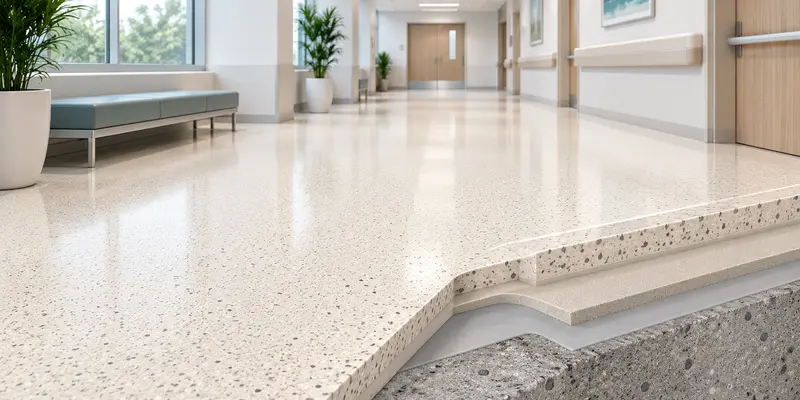
A decorative resin floor is an assembly, not a single pail. Ask the resin flooring supplier to identify every layer: substrate preparation, repair or leveling material, primer, intermediate layer, decorative polymer terrazzo coating and protective topcoat. Each layer should have a clear function and stated compatibility with the others.
The proposal should also explain where the standard build-up is insufficient. Existing tile, damp concrete, heavy traffic, wet cleaning or strong UV exposure may change the preparation, layer design, topcoat or suitable chemistry.
Ask which tests apply to one component and which apply to the whole assembly. Exclusions should be stated as clearly as advantages.
Audit the Epoxy Flooring Factory and Its Quality Controls

Confirm whether the seller manufactures the material, commissions another factory or resells finished goods. The buyer needs to know who controls the formula, production records, product release and corrective action.
For a physical or remote epoxy flooring factory audit, review raw-material storage, production instructions, test equipment, lot segregation, batch coding, records, packaging inspection and control of nonconforming material.
Ask the quality team to trace one batch from incoming materials to release and explain what happens when a raw material, pigment or formula changes. The answer should describe an operating process, not only show a certificate cover.
Factory size alone is not the decision. Qualified capacity for the proposed product, color, packaging and delivery window matters more than a large headline output number.
Request a TDS SDS Sample and Product-Specific Evidence
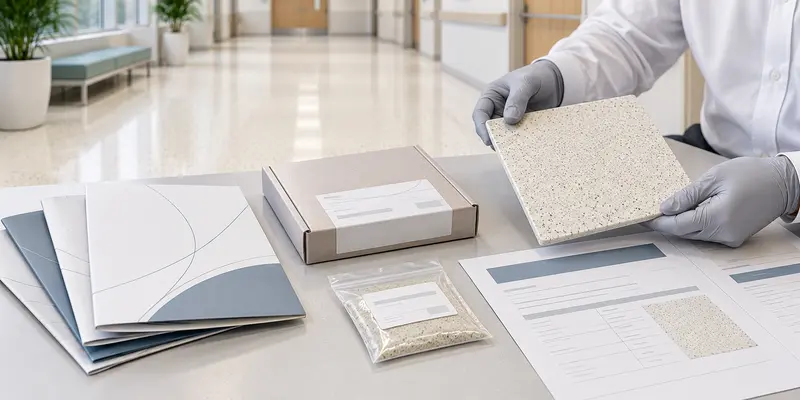
Buyers sometimes ask for a TDS SDS sample as if it were one document package, but the three items answer different questions. The technical data sheet describes product use and performance. The safety data sheet supports handling, storage and transport decisions. The physical sample allows the team to review color, texture, sheen and application behavior. None replaces the others.
Request the following before technical approval:
| Item | What it should confirm | What to check |
|---|---|---|
| Current TDS | Intended use, mix ratio, application conditions, cure stages, coverage and stated performance | Exact product name, revision date, units and limitations |
| Current SDS | Hazard, PPE, storage, spill, disposal and transport information | Legal entity, product identity, language and destination-market suitability |
| Test report or summary | Measured property under a stated method and condition | Tested product/build-up, laboratory, date, method, units and scope |
| Production-linked sample | Proposed color, texture, sheen and basic application behavior | Batch code, manufacture date and relationship to normal production |
| Installation guide | Preparation, mixing, tools, environment, layer sequence and curing precautions | Alignment with the proposed system and site conditions |
| Warranty terms | Covered defect, duration, exclusions and claim evidence | Division of responsibility among manufacturer, seller and installer |
Do not accept evidence for a “similar” coating without a documented technical basis. Certifications should match the legal entity, product, market, scope and validity period.
Test Batch Consistency Before Approving an OEM Floor Coating
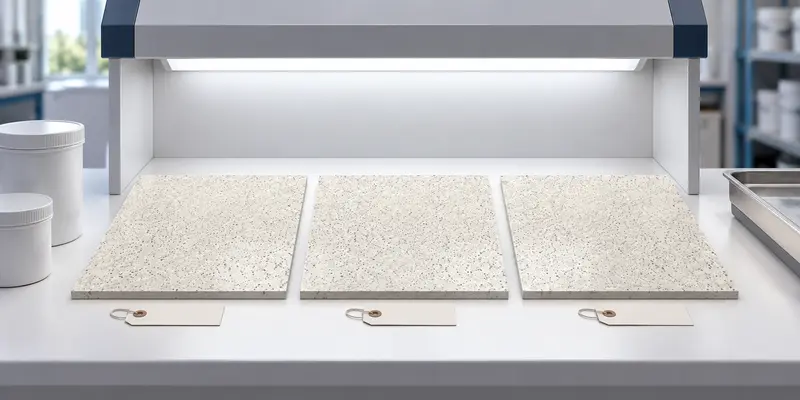
One hand-made sample does not prove normal-production consistency. Record the approved color, mineral distribution, texture, sheen, mix method, topcoat and viewing conditions.
For a large or repeat order, compare separate production batches or approve a pilot batch. Apply the proposed build-up and review color, mixing, flow, working time, texture and cure. Retain a labeled approved sample.
For an OEM floor coating, clarify whether customization covers color, mineral texture, finish, system, label, packaging or formula. A label change alone is not proof of formulation capability. Define ownership of specifications, artwork and market-specific documents.
The purchase order should require notification and reapproval for agreed critical changes.
Review Capacity, Packaging and Export Support From a Resin Flooring Supplier
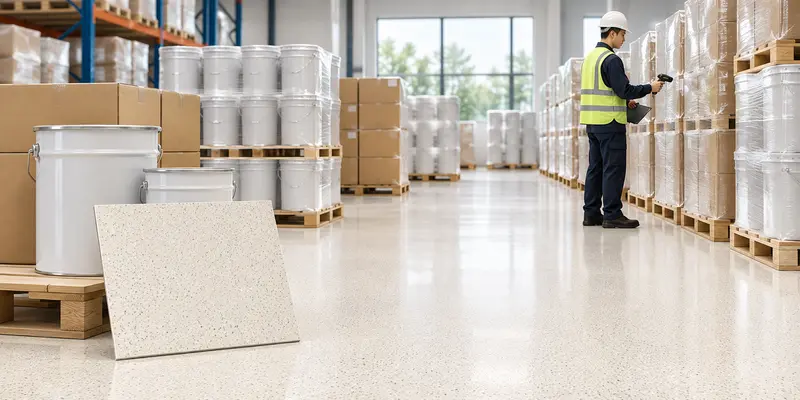
Ask about capacity for the specific product, not total factory output. Confirm production lots, color grouping, reserved slots and phased deliveries. Define whether lead time starts from sample approval, artwork approval, deposit or production release.
Packaging is part of product performance. Confirm kit size, A/B component identification, tamper sealing, batch label, shelf-life marking, carton or pallet protection, stack limits and storage temperature. For export orders, review the document and shipping responsibilities before production. The responsible resin flooring supplier should explain which documents it provides and which destination requirements remain with the importer or project team.
Where appropriate, retain labeled reserve material for phased work and repairs within the stated storage conditions and shelf life. It can reduce supply delay but cannot guarantee an invisible future repair.
Compare Technical and After-Sales Support From an Epoxy Flooring Factory

Technical support should begin before the order. Ask who reviews the substrate, build-up, mixing, site conditions, coverage and cure stages, and who answers installer questions or evaluates a site issue.
The epoxy flooring factory should define the evidence needed for a complaint, including batch, storage, mixing, substrate, site conditions, coverage, photos and retained material.
Confirm whether the warranty covers material or installed performance, its exclusions, investigation responsibility and remedy. A documented escalation route is more useful than an unlimited promise.
Use a Polymer Terrazzo Floor Coating Manufacturer Scorecard

Score suppliers only after every candidate has received the same project brief and submitted comparable evidence. The weighting below is a starting point. Increase technical fit and field support for difficult projects; increase supply continuity, packaging and OEM control for distribution programmes.
| Evaluation area | Suggested weight | Evidence to review |
|---|---|---|
| Project and system fit | 20 | Complete build-up, conditions, exclusions and project-specific recommendation |
| Technical documents and tests | 15 | Current TDS/SDS, relevant reports, installation guide and warranty |
| Manufacturing and batch control | 15 | Process records, batch codes, testing, traceability and change control |
| Sample and pilot approval | 10 | Production-linked sample, mock-up result and retained standard |
| Capacity and supply continuity | 15 | Qualified capacity, production plan, lead-time basis and contingency route |
| Packaging and export readiness | 10 | Kit identification, protection, labels, pallets and document responsibility |
| OEM/ODM capability | 5 | Defined customization scope, approval control and repeatability |
| Technical and after-sales support | 10 | Named technical contact, site guidance, claim process and response route |
| Total | 100 | Adjust the weighting to the project risk rather than accepting a universal pass score |
Use the score to structure the decision, not to hide missing essentials. A supplier with no product-specific safety document, no traceable sample or no compatible system proposal may need to be rejected even if its commercial score is strong.
DIMERY's current factory capabilities and quality assurance pages state 60 tons of daily capacity, batch testing, traceability, 21 kg kits and OEM/ODM support. The product page explains the system, while custom services covers color, texture, packaging and private-label options. Buyers should request the documents and samples for their exact order.
Ask These Questions Before Selecting an OEM Floor Coating Partner

Use the answers as procurement records rather than relying on a sales call summary:
Which legal entity manufactures and releases the proposed material?
Which primer, intermediate layer, decorative coat and topcoat form the offered system?
Which test reports apply to the exact product or complete assembly?
Can the approved sample be traced to a production batch?
How are color, mineral texture, cure and packaging checked between batches?
What changes require buyer notification and reapproval?
Which parts of the OEM floor coating programme are formula, color, packaging or label customization?
What starts the lead time, and which capacity is reserved for the order?
What technical support is available before, during and after application?
What does the warranty cover, exclude and require during a claim?
Red flags include documents with mismatched product names, reports with no test method or scope, samples with no batch identity, unclear manufacturing ownership, a quotation that omits system layers, a fixed lead-time promise before sample approval, or a warranty that never assigns investigation responsibility.
FAQs About a Polymer Terrazzo Floor Coating Manufacturer
What documents should I request before placing a bulk order?
Request the current TDS and SDS for every component, the installation guide, product-specific test evidence, warranty terms, packaging specification and complete system build-up. Add destination-market or tender documents where required. Check the product name, legal entity, revision date, test method, tested build-up and scope. A general company certificate does not prove every product claim.
How can I confirm that a supplier is the actual manufacturer?
Ask which legal entity owns the facility, controls the formula, issues the batch record and releases the product. Review storage, mixing, testing, filling, lot segregation and dispatch in person or by live video. Compare the company name and address across the quotation, invoice, TDS, SDS and reports. A distributor should disclose the manufacturing source and responsibility for changes, complaints and repeat supply.
Is one approved sample enough for a large flooring project?
One sample can confirm initial color and texture but may not demonstrate production consistency. For a large, phased or visually sensitive project, link it to a batch, approve the full build-up and consider a pilot batch or mock-up. Record the texture, sheen, topcoat, tools and lighting, retain a labeled standard and define how later batches will be compared.
What should be included in an OEM or private-label agreement?
Define the approved product code, color and finish, component ratio, kit size, label artwork, document responsibility, minimum order, trial process, production release, lead-time basis and change rules. State whether customization covers formula, color, texture, packaging or only branding. Also define confidentiality, ownership, acceptance criteria, retained samples, nonconforming-product handling and claim evidence. Approve changes before repeat production.
How should I compare MOQ, lead time and price between suppliers?
Align the system, specification, sample, packaging and document scope before comparing offers. A low MOQ may limit customization; a low price may omit primer, topcoat, export packing or support. Define what starts the lead time and whether it includes approval, production and dispatch. Compare freight, waste, delays, rework and repair risk as well as price per kit.
What information helps a manufacturer recommend the correct system?
Provide the area, substrate, moisture information, traffic, wheeled loads, spills, cleaners, wet-slip risk, sunlight, temperature, finish, location, required documents, installation window and delivery date. For distribution or private label, add order volume, reorder pattern, market, packaging language and customization scope. This allows the manufacturer to state a complete system, conditions and exclusions.
Choose a Resin Flooring Supplier on Evidence, Not Price
The right manufacturer is the one that can repeatedly deliver the agreed system and prove how it will be made, checked, documented, shipped, applied and supported. Use a common project brief, verify the actual production route, review product-specific documents, approve a traceable sample, test the supply plan and record responsibilities before comparing final commercial terms.
If you are evaluating DIMERY for a project, distribution programme or private-label range, send the substrate, area, traffic, finish, destination, schedule and expected order volume. Request samples, TDS/SDS or OEM details so the technical and commercial review can begin with the same evidence used in your supplier scorecard.
Related Articles
Clean Room Flooring Requirements: What Buyers Should Verify Before Ordering?
A buyer checklist for clean room flooring requirements: define the room, specify a complete hygienic resin system, compare options, request supplier documents and trial results, and use a procurement schedule.

How to Specify Resin Flooring for High-Traffic Public Buildings?
A public building flooring specification maps each zone to measured performance: traffic, slip risk, cleaning, indoor-air and fire documents, substrate and system build-up, installation phasing, and a supplier submittal checklist for approval and handover.
How to Control Color Variation in Large Resin Flooring Projects?
Color consistency on a large resin floor is controlled before, during, and after installation: approve a cured physical sample, allocate production batches by zone, standardize mixing and tools, check lighting, keep records, and retain repair material.
Slip-Resistant Epoxy Floor Coating: Anti-Slip or Easy to Clean?
The best resin floor is neither the roughest nor the smoothest. It achieves the project’s required traction under credible conditions and can be cleaned consistently with the facility’s real equipment, labor and chemistry.
How to Clean and Maintain Polymer Terrazzo Flooring?
Learn resin floor maintenance for polymer terrazzo flooring, including daily cleaning, safe tools, stain removal, high-traffic care and topcoat inspection.
How to Prep Concrete for Epoxy Coating Before Resin Flooring?
A step-by-step technical guide to preparing a concrete substrate before epoxy or resin flooring: moisture, strength, surface profile, cracks, contamination, site conditions, and a go/repair/mitigate/stop decision checklist.