How Much Polymer Terrazzo Floor Coating Do You Need per Square Meter?
Date: 14 August, 2026
Views: 1
Source: DIMERY
The amount of polymer terrazzo floor coating needed for a project depends on the net floor area, finish thickness, product consumption rate, substrate condition, system build-up, and jobsite allowance.
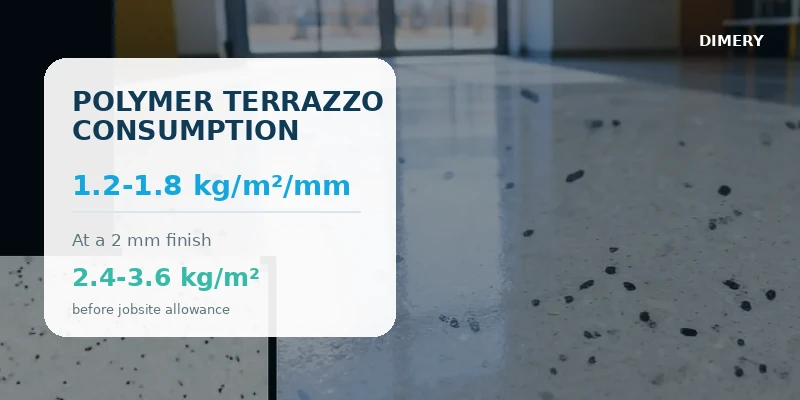
For the DIMERY polymer terrazzo finish, the theoretical consumption is approximately 1.2–1.8 kg/m²/mm. At a recommended final finish thickness of about 2 mm, the finish requires approximately 2.4–3.6 kg per square meter before waste. After adding a 5%–10% allowance, the practical planning range becomes approximately 2.52–3.96 kg/m².
This figure applies to the decorative finish only. Primer, intermediate coats, substrate repairs, leveling materials, and any protective topcoat must be calculated separately.
Polymer Terrazzo Floor Coating Consumption per Square Meter
| System item | Reference consumption |
|---|---|
| Primer | 0.1–0.3 kg/m² |
| Polymer terrazzo finish | 1.2–1.8 kg/m²/mm |
| Finish at 2 mm | 2.4–3.6 kg/m² |
| Recommended allowance | Add 5%–10% |
| Complete A/B package | 21 kg/set |
For a flat, stable, and properly prepared substrate, a 2 mm polymer terrazzo finish normally requires approximately 2.4–3.6 kg/m² before allowance.
The final quantity should not be determined by floor area alone. Porous concrete may absorb more primer, while an uneven floor may consume additional material to maintain the specified finish thickness.
Coverage figures for thin paint or roller coatings should not be used for a filled, self-leveling decorative flooring system. A statement such as “6 m² per litre” usually describes a much thinner film.
View the DIMERY polymer terrazzo floor coating for product and system information.
How to Calculate Epoxy Floor Coating Coverage per kg
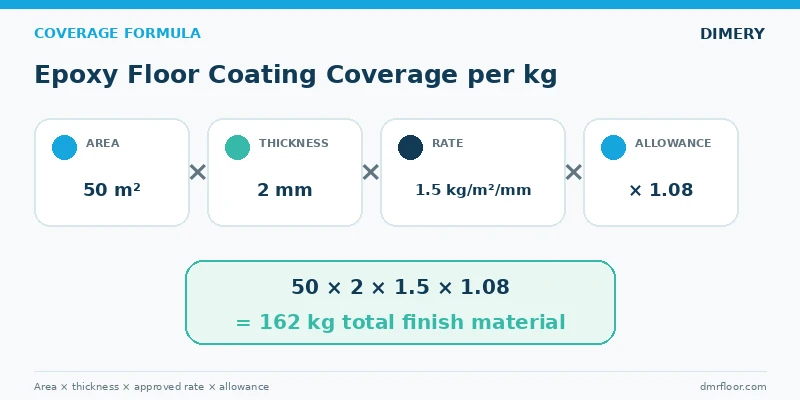
Formula: Finish quantity (kg) = Net area (m²) × Finish thickness (mm) × Consumption rate (kg/m²/mm) × Waste factor
Use 1.05 for a 5% allowance.
Use 1.08 for an 8% allowance.
Use 1.10 for a 10% allowance.
Epoxy floor coating coverage calculation example
For a 50 m² floor, 2 mm thickness, 1.5 kg/m²/mm rate, and 8% allowance:
Calculation: 50 × 2 × 1.5 × 1.08 = 162 kg
162 kg ÷ 21 kg/set = 7.71 sets. Round up to 8 complete sets, providing 168 kg of available material.
Reverse epoxy floor coating coverage per kg formula
Formula: Coverage per kg = 1 ÷ (Thickness × Consumption rate × Waste factor)
At 2 mm, 1.5 kg/m²/mm, and 8% allowance, the practical coverage is approximately 0.309 m² per kg.
How Epoxy Floor Coating Thickness Changes Material Use
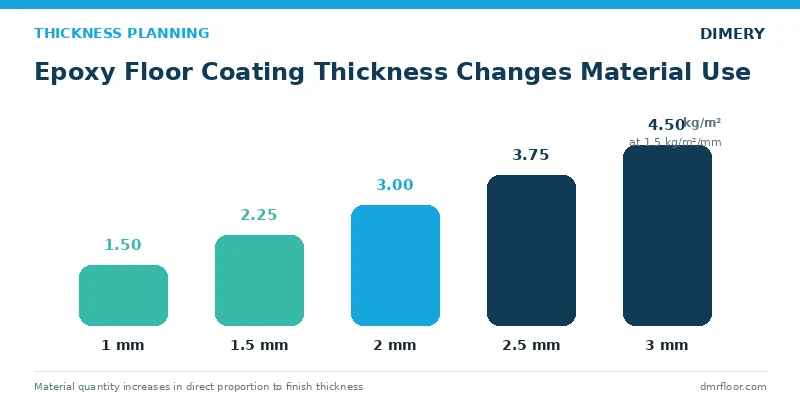
| Thickness | At 1.2 kg/m²/mm | At 1.5 kg/m²/mm | At 1.8 kg/m²/mm |
|---|---|---|---|
| 1.0 mm | 1.20 kg/m² | 1.50 kg/m² | 1.80 kg/m² |
| 1.5 mm | 1.80 kg/m² | 2.25 kg/m² | 2.70 kg/m² |
| 2.0 mm | 2.40 kg/m² | 3.00 kg/m² | 3.60 kg/m² |
| 2.5 mm | 3.00 kg/m² | 3.75 kg/m² | 4.50 kg/m² |
| 3.0 mm | 3.60 kg/m² | 4.50 kg/m² | 5.40 kg/m² |
When the rate is expressed in kg/m²/mm, material use rises in direct proportion to thickness. Increasing the finish from 2 mm to 3 mm increases the finish quantity by 50%.
Confirm the approved thickness before quoting or ordering. Major substrate irregularities should be corrected with a separate repair or leveling layer rather than absorbed into the decorative finish.
Resin Flooring Materials Must Be Calculated Layer by Layer
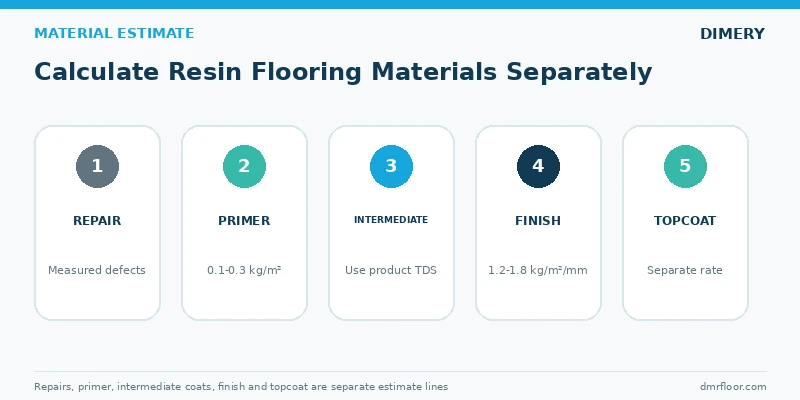
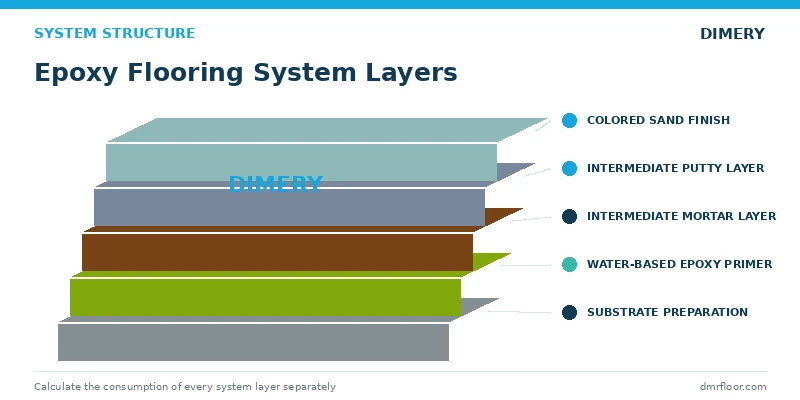
A complete estimate must separate all resin flooring materials. Each layer has its own function, thickness, density, consumption rate, and packaging.
Substrate repair materials
Primer
Intermediate mortar or putty
Leveling layer
Decorative polymer terrazzo finish
Transparent or functional topcoat
Joint, cove, and edge materials
Repairs, broad leveling, coves, and joints should remain visible as separate estimate lines. They should not be hidden inside a general waste allowance.
Epoxy Flooring System Layers and Reference Consumption
Primer calculation
DIMERY primer is normally estimated at 0.1–0.3 kg/m², depending on substrate porosity.
Formula: Primer quantity = Area × Primer rate × Waste factor
For 100 m² at 0.20 kg/m² and 8% allowance: 100 × 0.20 × 1.08 = 21.6 kg. Very porous concrete may require more primer, so use a trial area when the substrate is open or inconsistent.
Intermediate-layer calculation
Mortar, putty, and leveling layers must be calculated from the approved system build-up and technical data. Do not assume they are included in the finish consumption rate.
Polymer terrazzo finish calculation
Example: 100 × 2 × 1.5 × 1.08 = 324 kg finish. 324 ÷ 21 = 15.43 sets, so order 16 complete sets.
Protective topcoat calculation
If the flooring system includes a transparent or functional topcoat, calculate it separately using its own consumption rate.
See the DIMERY installation guide for surface preparation and application requirements.
Self Leveling Epoxy Floor Coating Quantity Examples
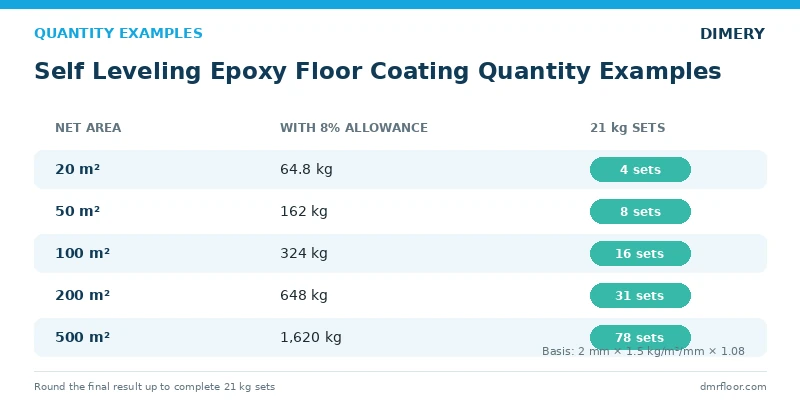
The following examples use a 1.5 kg/m²/mm finish rate, 2 mm thickness, 8% allowance, and 21 kg complete sets.
| Net area | Before waste | With 8% waste | 21 kg sets |
|---|---|---|---|
| 20 m² | 60 kg | 64.8 kg | 4 sets |
| 50 m² | 150 kg | 162 kg | 8 sets |
| 100 m² | 300 kg | 324 kg | 16 sets |
| 200 m² | 600 kg | 648 kg | 31 sets |
| 500 m² | 1,500 kg | 1,620 kg | 78 sets |
One-set coverage: 21 ÷ (2 × 1.5 × 1.08) = approximately 6.48 m² per set.
These figures are planning examples. Replace the sample rate, thickness, and allowance with the approved project values before ordering.
What Changes Resin Floor Coating Coverage on Site?
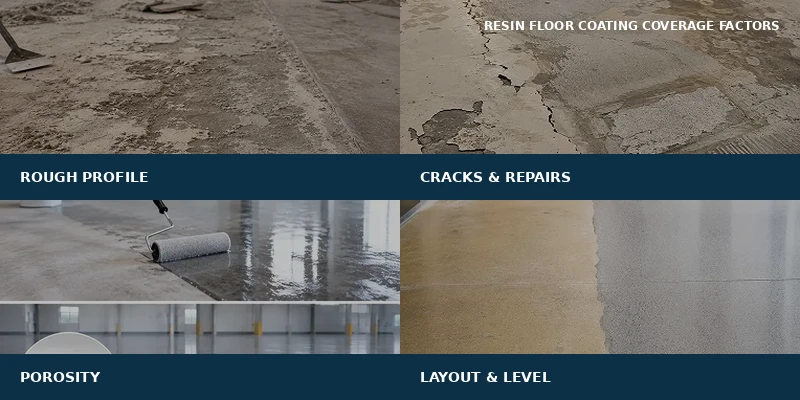
Theoretical resin floor coating coverage assumes a prepared, reasonably flat substrate and controlled application. Actual site use can change for the following reasons.
Substrate porosity
Open or absorbent concrete requires more primer and can create pinholes or dry areas.
Floor flatness
Low areas consume additional finish. Large deviations should be corrected before applying the decorative layer.
Surface profile
Grinding or shot blasting increases the actual surface area and can raise resin demand.
Cracks and repairs
Crack filling, patching, coves, joints, and transitions are separate quantities.
Application method
Crew size, mixing sequence, tool selection, placement route, and wet-edge control affect loss and consistency.
Layout complexity
Columns, narrow corridors, small rooms, color divisions, and stop-start zones normally increase waste.
For existing floors, review the DIMERY floor renovation solution before finalizing the estimate.
Epoxy Colored Sand Floor Coating Coverage per 21 kg Set
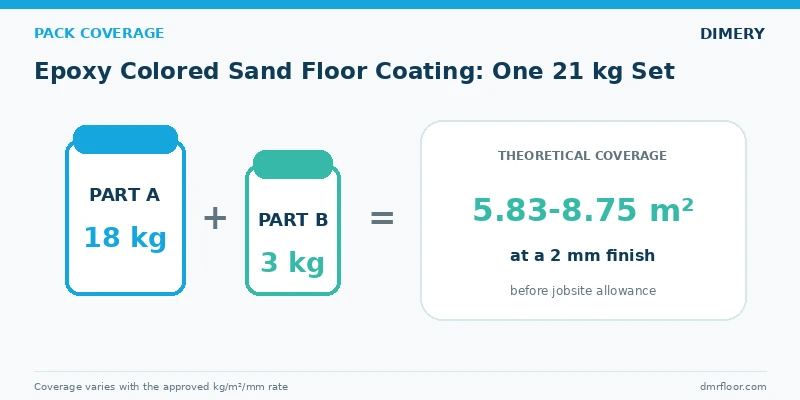
One complete DIMERY set contains 18 kg Part A and 3 kg Part B, for a total of 21 kg.
| Finish rate at 2 mm | Theoretical coverage per 21 kg set |
|---|---|
| 1.2 kg/m²/mm | 8.75 m² |
| 1.5 kg/m²/mm | 7.00 m² |
| 1.8 kg/m²/mm | 5.83 m² |
Actual coverage is lower after adding a jobsite allowance. At the middle rate of 1.5 kg/m²/mm with 8% allowance, practical coverage is about 6.48 m² per set. For complex layouts or uncertain substrates, plan toward the lower end of the coverage range.
Epoxy Floor Coating Mixing Ratio and Full-Pack Rounding
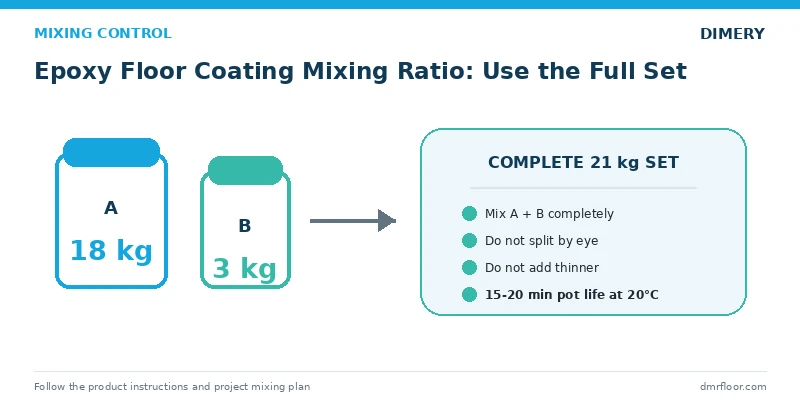
The correct DIMERY package ratio is 18 kg Part A plus 3 kg Part B. For reliable site control, mix complete sets and preserve the specified ratio.
Do not divide the package visually.
Do not change the resin-to-hardener ratio.
Do not add thinner to extend coverage.
Do not place material after its working time has expired.
Do not mix partial amounts from different batches without approved measuring equipment and manufacturer confirmation.
Calculate the required kilograms first, divide by 21 kg, and round up to complete sets. At 20°C, the referenced mixed material has a practical working time of about 15–20 minutes, so crew size and work zones should be planned before mixing starts.
Polymer Terrazzo Flooring Estimate Checklist
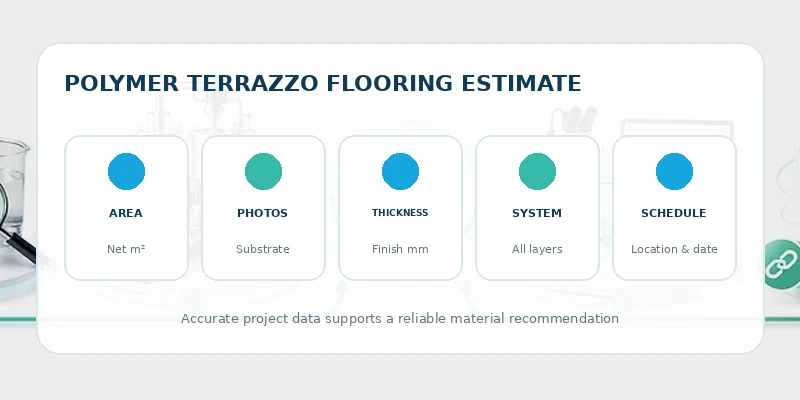
| Project information | Why it matters |
|---|---|
| Total net coated area | Establishes the base quantity. |
| Country and city | Affects climate, logistics, and shipping. |
| New construction or renovation | Defines likely preparation work. |
| Substrate type | Influences adhesion and system selection. |
| Photos of cracks, contamination, and irregularities | Reveals repair and risk items. |
| Flatness or leveling information | Identifies extra material outside the finish. |
| Moisture test results | Helps assess moisture-related risk. |
| Required finish thickness | Directly controls finish quantity. |
| Specified system layers | Keeps each material calculation separate. |
| Color and texture target | Supports samples and batch planning. |
| Work zones and access | Affects sequence and waste. |
| Schedule | Affects production, delivery, and installation planning. |
Representative site photos are especially important. Wide views should show the overall floor, while close-ups should show cracks, joints, coatings, contamination, repairs, and local low areas.
Polymer Terrazzo Floor Coating FAQs
How much polymer terrazzo floor coating is needed for 1 m²?
At 1.2–1.8 kg/m²/mm, a 2 mm finish needs approximately 2.4–3.6 kg/m² before waste, or about 2.52–3.96 kg/m² after adding 5%–10%.
Does the finish consumption rate include primer?
No. Primer is calculated separately, normally at approximately 0.1–0.3 kg/m² depending on substrate porosity.
How many square meters can one 21 kg set cover?
At 2 mm, theoretical coverage is approximately 5.83–8.75 m² per set. At the middle rate with 8% allowance, practical coverage is about 6.48 m².
Can resin flooring materials be calculated in litres?
Only when product density and the correct wet- or dry-film basis are known. For a filled polymer terrazzo finish, kg/m²/mm is usually the more direct estimating unit.
Is a 10% allowance always enough?
No. Uneven substrates, difficult access, repairs, complex details, and small work zones can require a higher project-specific allowance.
Should columns and penetrations be deducted?
Deduct large non-coated areas. For small penetrations, the saved area may be offset by extra edge work and waste, so document the estimating rule used.
Can Part A and Part B be divided for later use?
Full-pack mixing is the safer site standard. Partial mixing should only be used when accurate measuring equipment is available and the manufacturer permits it.
Polymer Terrazzo Flooring System: Final Quantity Check
For planning, use 1.2–1.8 kg/m²/mm for the DIMERY polymer terrazzo finish. At 2 mm, this equals 2.4–3.6 kg/m² before allowance.
Confirm the net coated area.
Confirm the approved finish thickness.
Calculate each system layer separately.
Add a realistic site allowance.
Divide the finish quantity by 21 kg and round up.
Keep repairs and major leveling separate.
Verify the estimate with project photos and test data.
For a project-specific quantity check, send the net area, substrate photos, project location, required thickness, service environment, color and texture target, and installation schedule to DIMERY.
The amount of polymer terrazzo floor coating needed for a project depends on the net floor area, finish thickness, product consumption rate, substrate condition, system build-up, and jobsite allowance.
For the DIMERY polymer terrazzo finish, the theoretical consumption is approximately 1.2–1.8 kg/m²/mm. At a recommended final finish thickness of about 2 mm, the finish requires approximately 2.4–3.6 kg per square meter before waste. After adding a 5%–10% allowance, the practical planning range becomes approximately 2.52–3.96 kg/m².
This figure applies to the decorative finish only. Primer, intermediate coats, substrate repairs, leveling materials, and any protective topcoat must be calculated separately.
Polymer Terrazzo Floor Coating Consumption per Square Meter
| System item | Reference consumption |
|---|---|
| Primer | 0.1–0.3 kg/m² |
| Polymer terrazzo finish | 1.2–1.8 kg/m²/mm |
| Finish at 2 mm | 2.4–3.6 kg/m² |
| Recommended allowance | Add 5%–10% |
| Complete A/B package | 21 kg/set |
For a flat, stable, and properly prepared substrate, a 2 mm polymer terrazzo finish normally requires approximately 2.4–3.6 kg/m² before allowance.
The final quantity should not be determined by floor area alone. Porous concrete may absorb more primer, while an uneven floor may consume additional material to maintain the specified finish thickness.
Coverage figures for thin paint or roller coatings should not be used for a filled, self-leveling decorative flooring system. A statement such as “6 m² per litre” usually describes a much thinner film.
View the DIMERY polymer terrazzo floor coating for product and system information.
How to Calculate Epoxy Floor Coating Coverage per kg
Formula: Finish quantity (kg) = Net area (m²) × Finish thickness (mm) × Consumption rate (kg/m²/mm) × Waste factor
Use 1.05 for a 5% allowance.
Use 1.08 for an 8% allowance.
Use 1.10 for a 10% allowance.
Epoxy floor coating coverage calculation example
For a 50 m² floor, 2 mm thickness, 1.5 kg/m²/mm rate, and 8% allowance:
Calculation: 50 × 2 × 1.5 × 1.08 = 162 kg
162 kg ÷ 21 kg/set = 7.71 sets. Round up to 8 complete sets, providing 168 kg of available material.
Reverse epoxy floor coating coverage per kg formula
Formula: Coverage per kg = 1 ÷ (Thickness × Consumption rate × Waste factor)
At 2 mm, 1.5 kg/m²/mm, and 8% allowance, the practical coverage is approximately 0.309 m² per kg.
How Epoxy Floor Coating Thickness Changes Material Use
| Thickness | At 1.2 kg/m²/mm | At 1.5 kg/m²/mm | At 1.8 kg/m²/mm |
|---|---|---|---|
| 1.0 mm | 1.20 kg/m² | 1.50 kg/m² | 1.80 kg/m² |
| 1.5 mm | 1.80 kg/m² | 2.25 kg/m² | 2.70 kg/m² |
| 2.0 mm | 2.40 kg/m² | 3.00 kg/m² | 3.60 kg/m² |
| 2.5 mm | 3.00 kg/m² | 3.75 kg/m² | 4.50 kg/m² |
| 3.0 mm | 3.60 kg/m² | 4.50 kg/m² | 5.40 kg/m² |
When the rate is expressed in kg/m²/mm, material use rises in direct proportion to thickness. Increasing the finish from 2 mm to 3 mm increases the finish quantity by 50%.
Confirm the approved thickness before quoting or ordering. Major substrate irregularities should be corrected with a separate repair or leveling layer rather than absorbed into the decorative finish.
Resin Flooring Materials Must Be Calculated Layer by Layer
A complete estimate must separate all resin flooring materials. Each layer has its own function, thickness, density, consumption rate, and packaging.
Substrate repair materials
Primer
Intermediate mortar or putty
Leveling layer
Decorative polymer terrazzo finish
Transparent or functional topcoat
Joint, cove, and edge materials
Repairs, broad leveling, coves, and joints should remain visible as separate estimate lines. They should not be hidden inside a general waste allowance.
Epoxy Flooring System Layers and Reference Consumption
Primer calculation
DIMERY primer is normally estimated at 0.1–0.3 kg/m², depending on substrate porosity.
Formula: Primer quantity = Area × Primer rate × Waste factor
For 100 m² at 0.20 kg/m² and 8% allowance: 100 × 0.20 × 1.08 = 21.6 kg. Very porous concrete may require more primer, so use a trial area when the substrate is open or inconsistent.
Intermediate-layer calculation
Mortar, putty, and leveling layers must be calculated from the approved system build-up and technical data. Do not assume they are included in the finish consumption rate.
Polymer terrazzo finish calculation
Example: 100 × 2 × 1.5 × 1.08 = 324 kg finish. 324 ÷ 21 = 15.43 sets, so order 16 complete sets.
Protective topcoat calculation
If the flooring system includes a transparent or functional topcoat, calculate it separately using its own consumption rate.
See the DIMERY installation guide for surface preparation and application requirements.
Self Leveling Epoxy Floor Coating Quantity Examples
The following examples use a 1.5 kg/m²/mm finish rate, 2 mm thickness, 8% allowance, and 21 kg complete sets.
| Net area | Before waste | With 8% waste | 21 kg sets |
|---|---|---|---|
| 20 m² | 60 kg | 64.8 kg | 4 sets |
| 50 m² | 150 kg | 162 kg | 8 sets |
| 100 m² | 300 kg | 324 kg | 16 sets |
| 200 m² | 600 kg | 648 kg | 31 sets |
| 500 m² | 1,500 kg | 1,620 kg | 78 sets |
One-set coverage: 21 ÷ (2 × 1.5 × 1.08) = approximately 6.48 m² per set.
These figures are planning examples. Replace the sample rate, thickness, and allowance with the approved project values before ordering.
What Changes Resin Floor Coating Coverage on Site?
Theoretical resin floor coating coverage assumes a prepared, reasonably flat substrate and controlled application. Actual site use can change for the following reasons.
Substrate porosity
Open or absorbent concrete requires more primer and can create pinholes or dry areas.
Floor flatness
Low areas consume additional finish. Large deviations should be corrected before applying the decorative layer.
Surface profile
Grinding or shot blasting increases the actual surface area and can raise resin demand.
Cracks and repairs
Crack filling, patching, coves, joints, and transitions are separate quantities.
Application method
Crew size, mixing sequence, tool selection, placement route, and wet-edge control affect loss and consistency.
Layout complexity
Columns, narrow corridors, small rooms, color divisions, and stop-start zones normally increase waste.
For existing floors, review the DIMERY floor renovation solution before finalizing the estimate.
Epoxy Colored Sand Floor Coating Coverage per 21 kg Set
One complete DIMERY set contains 18 kg Part A and 3 kg Part B, for a total of 21 kg.
| Finish rate at 2 mm | Theoretical coverage per 21 kg set |
|---|---|
| 1.2 kg/m²/mm | 8.75 m² |
| 1.5 kg/m²/mm | 7.00 m² |
| 1.8 kg/m²/mm | 5.83 m² |
Actual coverage is lower after adding a jobsite allowance. At the middle rate of 1.5 kg/m²/mm with 8% allowance, practical coverage is about 6.48 m² per set. For complex layouts or uncertain substrates, plan toward the lower end of the coverage range.
Epoxy Floor Coating Mixing Ratio and Full-Pack Rounding
The correct DIMERY package ratio is 18 kg Part A plus 3 kg Part B. For reliable site control, mix complete sets and preserve the specified ratio.
Do not divide the package visually.
Do not change the resin-to-hardener ratio.
Do not add thinner to extend coverage.
Do not place material after its working time has expired.
Do not mix partial amounts from different batches without approved measuring equipment and manufacturer confirmation.
Calculate the required kilograms first, divide by 21 kg, and round up to complete sets. At 20°C, the referenced mixed material has a practical working time of about 15–20 minutes, so crew size and work zones should be planned before mixing starts.
Polymer Terrazzo Flooring Estimate Checklist
| Project information | Why it matters |
|---|---|
| Total net coated area | Establishes the base quantity. |
| Country and city | Affects climate, logistics, and shipping. |
| New construction or renovation | Defines likely preparation work. |
| Substrate type | Influences adhesion and system selection. |
| Photos of cracks, contamination, and irregularities | Reveals repair and risk items. |
| Flatness or leveling information | Identifies extra material outside the finish. |
| Moisture test results | Helps assess moisture-related risk. |
| Required finish thickness | Directly controls finish quantity. |
| Specified system layers | Keeps each material calculation separate. |
| Color and texture target | Supports samples and batch planning. |
| Work zones and access | Affects sequence and waste. |
| Schedule | Affects production, delivery, and installation planning. |
Representative site photos are especially important. Wide views should show the overall floor, while close-ups should show cracks, joints, coatings, contamination, repairs, and local low areas.
Polymer Terrazzo Floor Coating FAQs
How much polymer terrazzo floor coating is needed for 1 m²?
At 1.2–1.8 kg/m²/mm, a 2 mm finish needs approximately 2.4–3.6 kg/m² before waste, or about 2.52–3.96 kg/m² after adding 5%–10%.
Does the finish consumption rate include primer?
No. Primer is calculated separately, normally at approximately 0.1–0.3 kg/m² depending on substrate porosity.
How many square meters can one 21 kg set cover?
At 2 mm, theoretical coverage is approximately 5.83–8.75 m² per set. At the middle rate with 8% allowance, practical coverage is about 6.48 m².
Can resin flooring materials be calculated in litres?
Only when product density and the correct wet- or dry-film basis are known. For a filled polymer terrazzo finish, kg/m²/mm is usually the more direct estimating unit.
Is a 10% allowance always enough?
No. Uneven substrates, difficult access, repairs, complex details, and small work zones can require a higher project-specific allowance.
Should columns and penetrations be deducted?
Deduct large non-coated areas. For small penetrations, the saved area may be offset by extra edge work and waste, so document the estimating rule used.
Can Part A and Part B be divided for later use?
Full-pack mixing is the safer site standard. Partial mixing should only be used when accurate measuring equipment is available and the manufacturer permits it.
Polymer Terrazzo Flooring System: Final Quantity Check
For planning, use 1.2–1.8 kg/m²/mm for the DIMERY polymer terrazzo finish. At 2 mm, this equals 2.4–3.6 kg/m² before allowance.
Confirm the net coated area.
Confirm the approved finish thickness.
Calculate each system layer separately.
Add a realistic site allowance.
Divide the finish quantity by 21 kg and round up.
Keep repairs and major leveling separate.
Verify the estimate with project photos and test data.
For a project-specific quantity check, send the net area, substrate photos, project location, required thickness, service environment, color and texture target, and installation schedule to DIMERY.
Related Articles
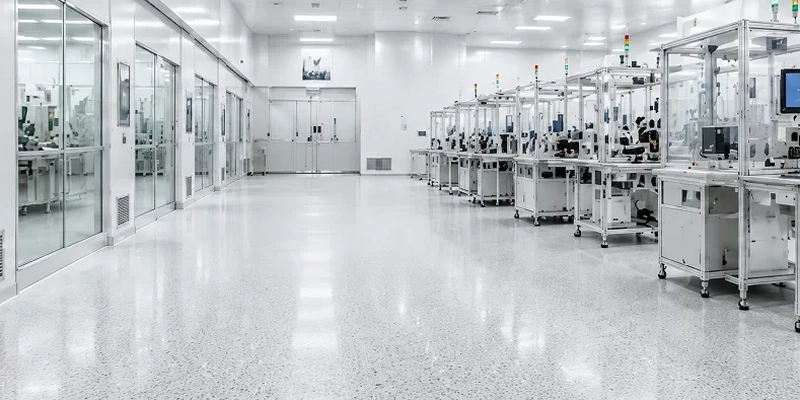
Clean Room Flooring Requirements: What Buyers Should Verify Before Ordering?
A buyer checklist for clean room flooring requirements: define the room, specify a complete hygienic resin system, compare options, request supplier documents and trial results, and use a procurement schedule.

How to Choose a Polymer Terrazzo Floor Coating Manufacturer?
A neutral, evidence-first buyer guide and supplier scorecard for evaluating a polymer terrazzo floor coating manufacturer across documents, samples, batch control, OEM, packaging, supply and after-sales support.
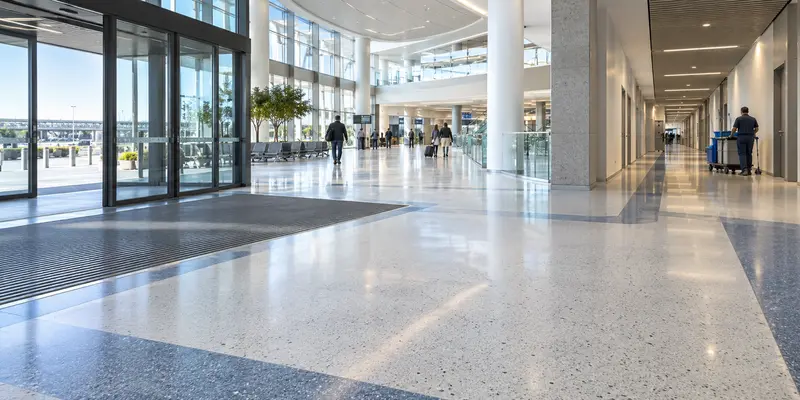
How to Specify Resin Flooring for High-Traffic Public Buildings?
A public building flooring specification maps each zone to measured performance: traffic, slip risk, cleaning, indoor-air and fire documents, substrate and system build-up, installation phasing, and a supplier submittal checklist for approval and handover.
How to Control Color Variation in Large Resin Flooring Projects?
Color consistency on a large resin floor is controlled before, during, and after installation: approve a cured physical sample, allocate production batches by zone, standardize mixing and tools, check lighting, keep records, and retain repair material.
Slip-Resistant Epoxy Floor Coating: Anti-Slip or Easy to Clean?
The best resin floor is neither the roughest nor the smoothest. It achieves the project’s required traction under credible conditions and can be cleaned consistently with the facility’s real equipment, labor and chemistry.
How to Clean and Maintain Polymer Terrazzo Flooring?
Learn resin floor maintenance for polymer terrazzo flooring, including daily cleaning, safe tools, stain removal, high-traffic care and topcoat inspection.